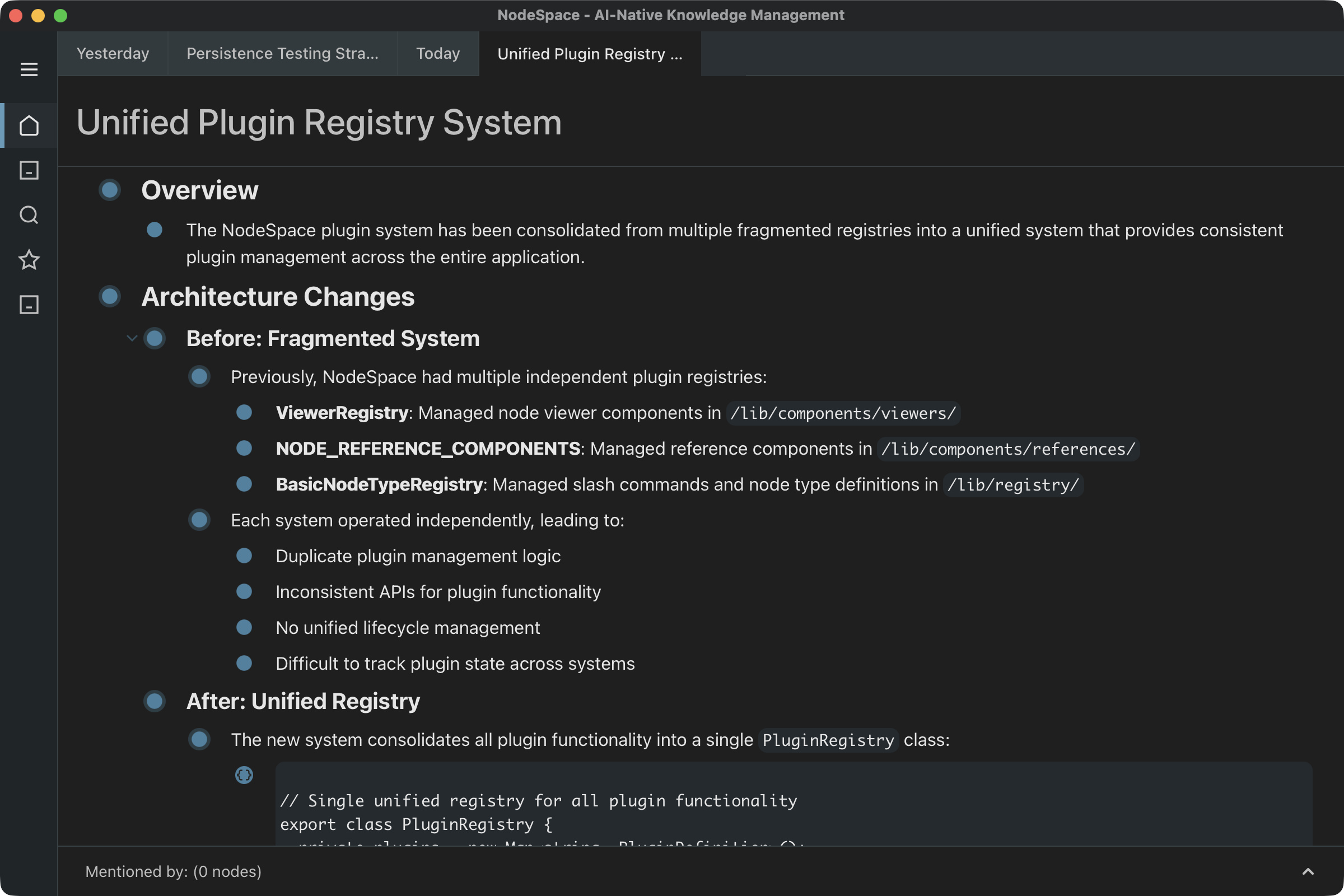
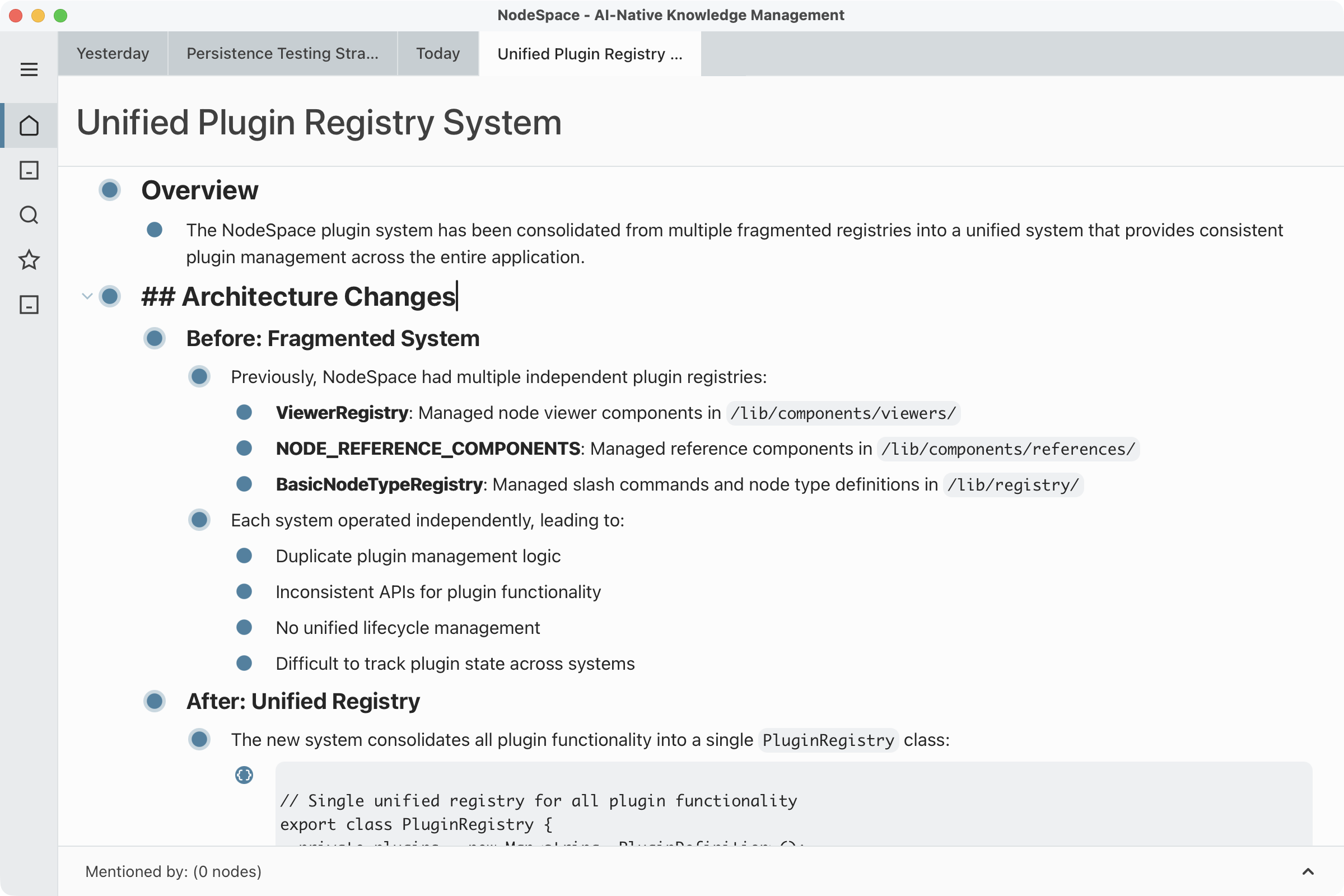
The workspace for agentic development. Specs, plans, decisions and your team's conventions live in one local graph, and every coding agent works from it: what to build, what governs it, and how your team does it.
Works with Claude Code, Codex, Antigravity CLI, OpenCode and Pi · Free and open source · Mac, Windows, Linux
How good an agent is depends on the context it starts with. Here's how teams get there, and where each step runs out.
Copy, paste and re-explain every session. The context lives in your head.
MCP into Jira, Linear or Notion. The context lives in tools built for people, and the agent has to know what to search for. Every connected tool adds its own definitions and results to the context window.
Specs, decisions and conventions live as markdown in the repo, starting with CLAUDE.md. It's a collection of flat files: the agent greps for them, nothing connects one to another, and they're only as current as each checkout's last pull. Following them is optional.
Each task starts with the right context already composed: its spec, the decisions behind it, and the conventions that apply. It's all connected in one graph, so the agent follows links instead of guessing. One source, current for everyone, and the process is enforced, not suggested.
NodeSpace takes you to step four, without building it yourself.
| In a repo | In NodeSpace |
|---|---|
| Grep finds matching words | Search understands what the agent is asking for |
| "See ADR-032" is just text | Links between nodes are real, and can be followed |
| Status and criteria are prose | Typed nodes and saved queries make status something you can ask for |
| Anyone can skip the process | A rule can reject a write that skips a step |
| A policy change is a PR in every repo | Change it once and every agent sees it |
Agents fetch the skills and schemas for the task at hand through the CLI, and the skill installer sets this up for Claude Code, Codex, Antigravity CLI, OpenCode and Pi. MCP covers surfaces with no shell.
A play is a set of rules. Each rule has a trigger (an event in the graph), conditions it checks, and actions that update the graph: change a node, create and link nodes, or reject a write. View plays in the app and switch them on and off.
Plays are data, not code. Edit a rule, switch one off, or save a new view. No fork, no plugin.
A new security policy or a new review step usually means a pull request to every repository's instruction files, and agents on older branches keep working to the old rules. In NodeSpace, it's one edit, and every agent works from it.
Across a team, this needs NodeSpace Sync, which is in active development.
Lookups run on your machine in milliseconds, so agents can check context throughout a task instead of loading one big blob up front.
Search and embeddings run inside the app, with no per-query cloud bill. That's why the core product is free.
Your knowledge stays on your hardware and works offline. NodeSpace is a standalone desktop app: nothing to host, no Docker, no database to set up.
NodeSpace Sync (for teams)
NodeSpace Sync keeps your workspace in sync across your team and devices. It is in active development, and available to those who want to try it. When one person records a decision or changes a policy, everyone's agents work from it on their next task.
| Capability | NodeSpace | NodeSpace Sync (for teams) |
|---|---|---|
| Local knowledge graph and semantic search | Yes | Yes |
| Agent access through CLI skills and MCP | Yes | Yes |
| Plays, saved queries and boards | Yes | Yes |
| Desktop app | Yes | Yes |
| Team synchronization (in active development) | No | Yes |
| Availability | Free, open source | Early access |
NodeSpace is free and open source. Install it, connect your coding agent, and it has your team's context by the next session.
brew install --cask nodespaceai/nodespace/nodespace
Questions or feedback? Join us on Discord.
Agents read and write through the CLI. You review, edit and organize in the app. Both work on the same graph.
Tasks and your own types, each with the structure it needs.
Kanban, lists and tables over any query.
Capture context as you go.
Outline at any depth and link anything to anything.